

Mahmud II: The Reformer of the Crumbling Empire
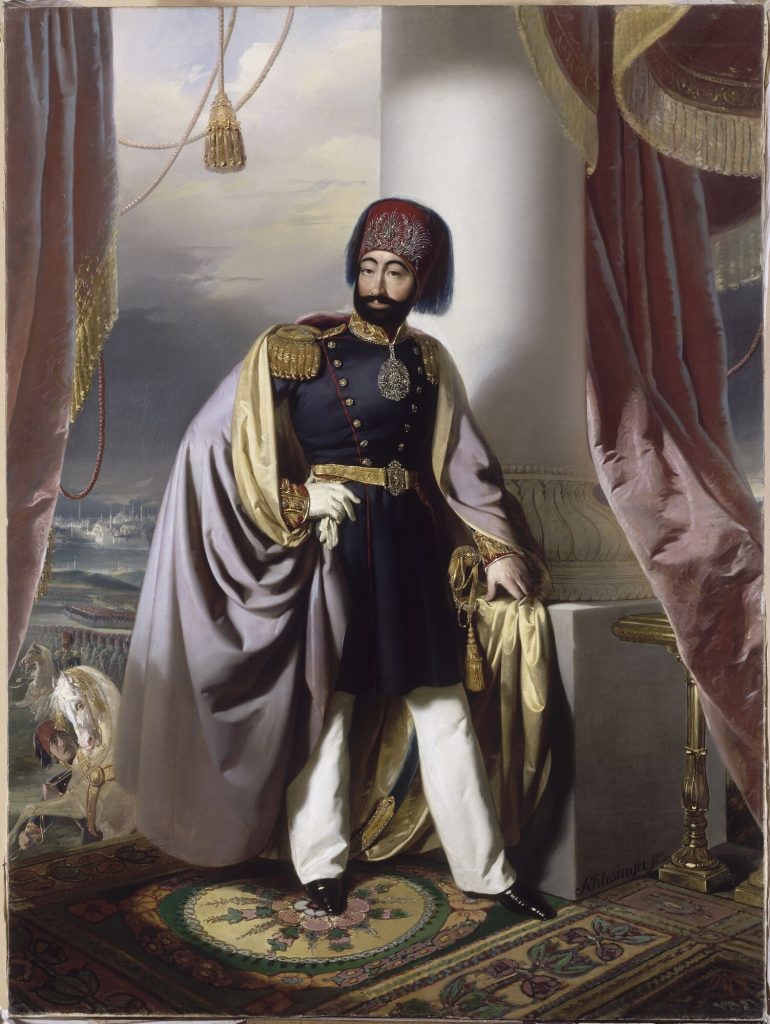
Mahmud II (reigned 1808–1839) was one of the most transformative Sultans of the Ottoman Empire. Often called the “Peter the Great of the East,” he inherited an empire nicknamed the “Sick Man of Europe” and spent his life trying to modernize it before it collapsed under the weight of internal corruption and external pressure.
1. The “Auspicious Incident”: Breaking the Janissaries
For centuries, the Janissaries—an elite military corps—had been the backbone of Ottoman power. However, by the 1800s, they had become a corrupt political mob that deposed Sultans at will.
In 1826, Mahmud II enacted his most famous reform, known as the Auspicious Incident. He provoked the Janissaries into a revolt, then used his new, European-trained artillery units to bombard their barracks in Istanbul. The corps was completely annihilated, clearing the path for a modern army based on Western models.
2. The Tanzimat and Cultural Westernization
Mahmud II didn’t just change the army; he changed the “face” of the empire. He introduced the Fez as the official headgear to replace the traditional turban, which was seen as a symbol of the old, stagnant order. He established a postal system, launched the first official Ottoman newspaper, and overhauled the bureaucracy. These reforms laid the groundwork for the Tanzimat, a period of intense modernization that continued after his death.
3. Ottoman Algeria: A Province at the Edge
The mention of ALGERIA, Ottoman in relation to Mahmud II marks a tragic chapter in his reign. While Mahmud was busy fighting wars in Greece and trying to modernize Istanbul, the outlying provinces were vulnerable.
- Semi-Independence: By the early 19th century, Algeria (the Regency of Algiers) was technically part of the Ottoman Empire but was ruled largely as an autonomous state by local Deys.
- The French Invasion (1830): In 1830, King Charles X of France launched an invasion of Algiers. Mahmud II, occupied with revolts in Egypt and the aftermath of the Greek War of Independence, was unable to send a fleet to defend the province.
- The Loss of North Africa: The fall of Algiers to the French in 1830 was a massive blow to Ottoman prestige. It marked the beginning of the end of Ottoman influence in North Africa and highlighted the “Sick Man’s” inability to protect his borders despite Mahmud’s internal reforms.
4. The Coinage of Mahmud II
In numismatics, the coinage of Mahmud II is highly distinct. Because he reigned for 31 years, his coins are often categorized by his “Regnal Year” (RY).
- The Tughra: His coins feature an elaborate Tughra (the Sultan’s calligraphic signature) on the obverse. Mahmud’s Tughra is particularly decorative, often flanked by flowers or branches.
- The Mint of Algiers: Coins minted in Algiers during his reign (prior to 1830) often feature a mix of Ottoman Turkish script and local North African styles. They are physical reminders of the last years of Turkish rule in the Maghreb.